
Luxembourg’s immigration audit: what changes and what does not
An external audit found weaknesses in the internal controls of Luxembourg’s immigration directorate. It does not, in itself, affect residence permits already issued. New applicants should expect closer scrutiny of their documents and, where relevant, the economic interest of their activity.
Illustration: Global Mobility Circle · All rights reserved
Three separate matters
As of 17 November 2026, three matters tend to be discussed together in Luxembourg: a criminal investigation, an administrative audit and the legal position of residence permit holders. They are related, but they carry different legal consequences.
The criminal investigation began in 2023 and concerns suspected corruption, forgery and other offences. In its statement of 7 July 2026, the Luxembourg public prosecutor’s office described suspected fraudulent immigration involving more than 200 third-country nationals, facilitated by fictitious addresses, employment contracts without economic substance and falsified qualifications or language certificates (Paperjam). The presumption of innocence applies.
The audit is a separate exercise. The report describes its remit as purely organisational and administrative, and independent of the criminal proceedings (Resultance audit, p. 3). It attributes no personal responsibility and does not review any individual permit. The conditions on which residence is granted, renewed or withdrawn are laid down by statute, and the audit itself does not amend them.
Timeline
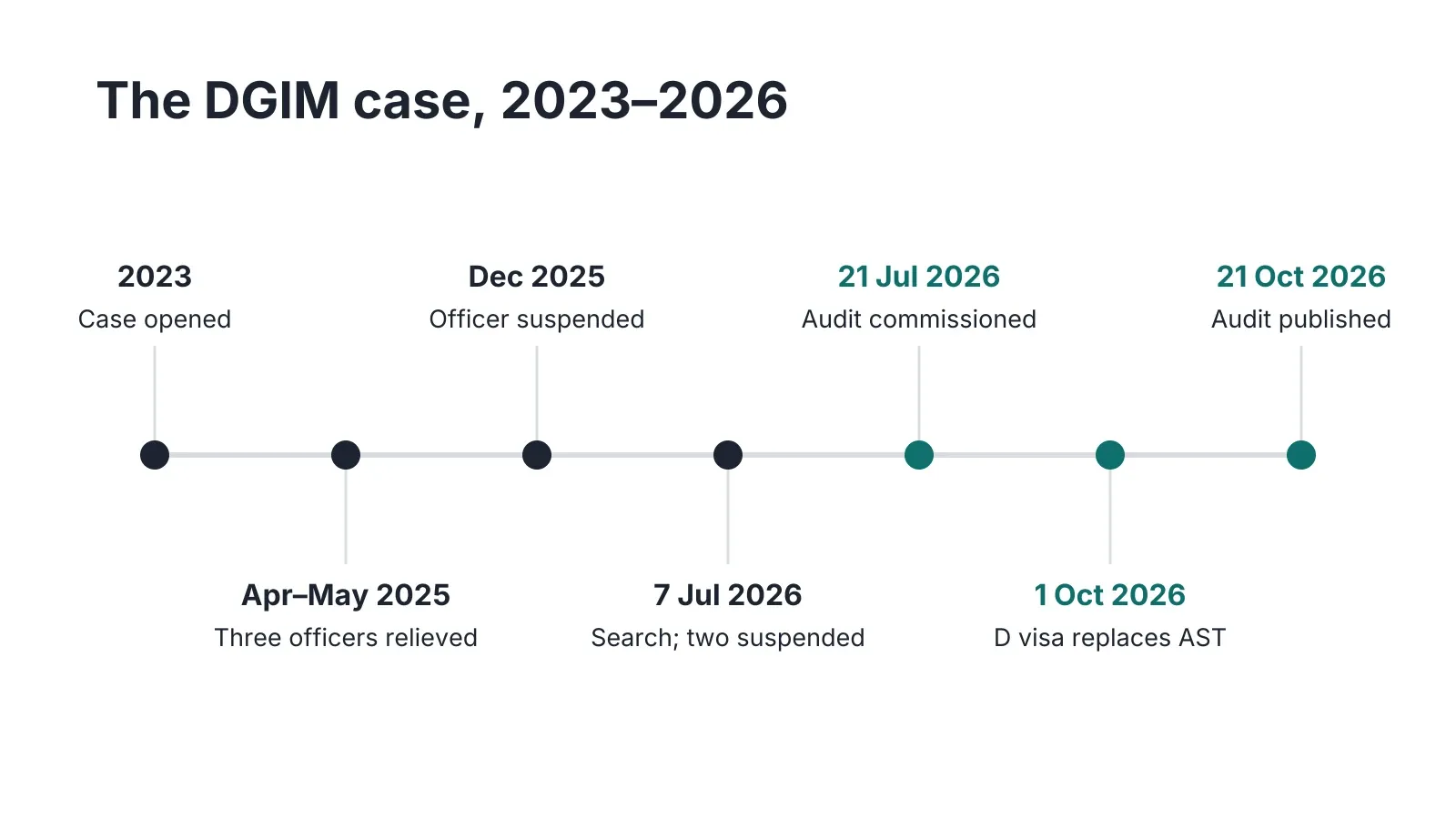
The case has unfolded over three years (Figure 1). After a search of the DGIM on 7 July 2026, the Ministry of Home Affairs commissioned an external audit from the consultancy Resultance. On 21 October 2026 the Minister for Home Affairs, Léon Gloden, presented the findings to the parliamentary home affairs committee, and the report was published.
The replacement of the temporary authorisation to stay (autorisation de séjour temporaire, AST) by a direct application for a long-stay visa (visa D) on 1 October 2026 is a separate reform. The Government Council approved it in July 2025, before the audit was commissioned.
What the audit examined and found
The audit covered five processes: the intake of applications, the AST for salaried workers, the AST for the EU Blue Card, the AST for self-employed persons, and the first residence permit issued after an AST (Resultance audit, p. 5). It examined the procedure in force before 1 October 2026. Renewals and the new D visa procedure fell outside its scope.
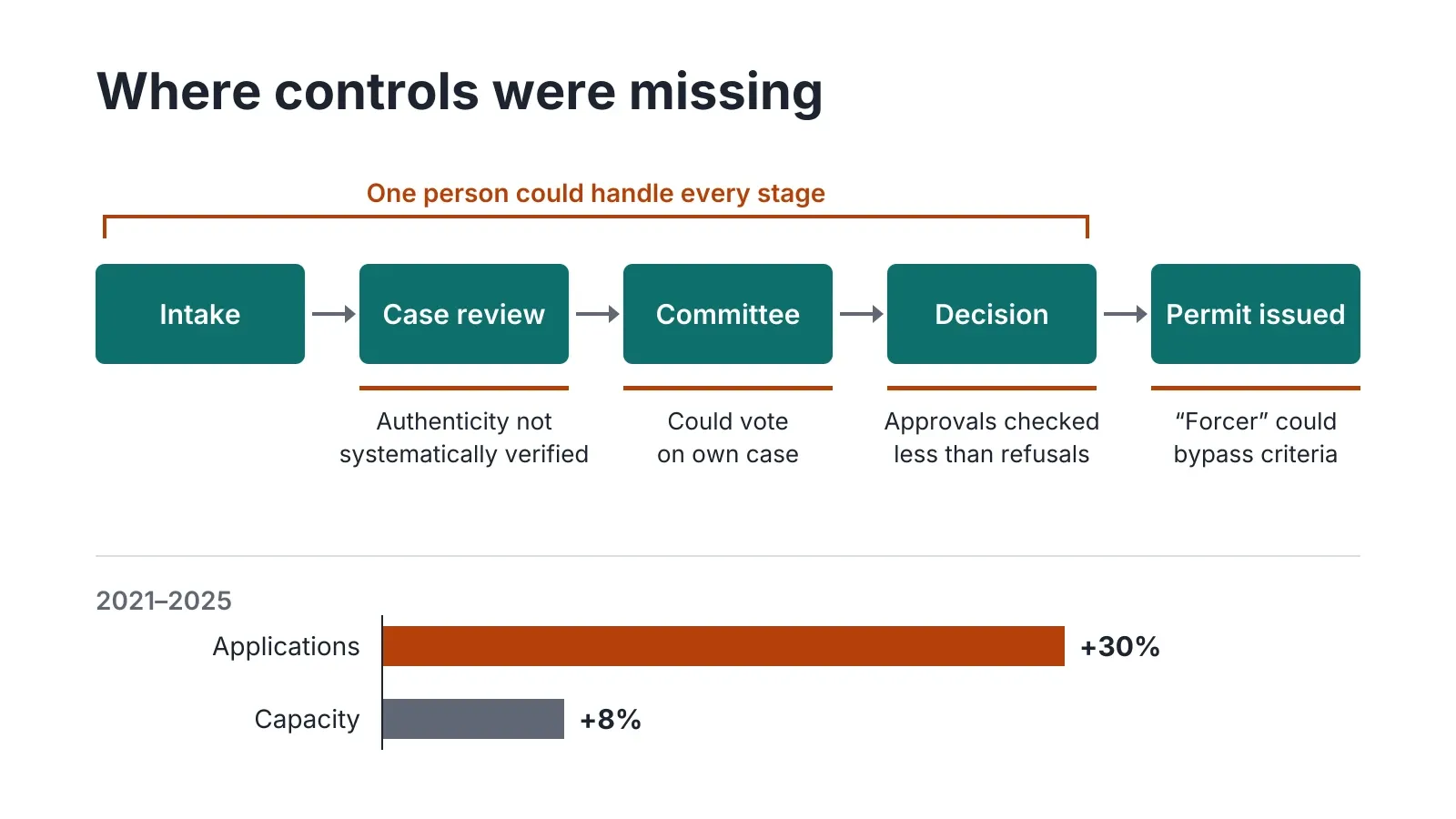
Figure 2 shows where controls were missing along the path of an application. Access rights were broad: an official could hold editing rights at several stages of the same case, no alert was raised when one person handled every stage, and all staff had access to an archive of more than 685,000 paper files. A function called “Forcer” allowed a decision without every criterion in the standard workflow being validated, with no reason required and no specific alert. Approvals were not always reviewed as thoroughly as refusals. In the committees that deliver opinions, a substitute member could vote on a case he or she had prepared, and opinions were not systematically recorded. Because files ran in parallel on paper and in the electronic system, it was not always possible to establish who had checked what.
Two findings deserve closer attention.
Document authenticity. The authenticity of diplomas and certificates was not systematically verified. Where a diploma had not been recognised in advance, its authenticity was left to the case officer, whose checks were sometimes limited and time-consuming (Resultance audit, p. 14). Where the education ministries had recognised a diploma, or the employment agency (ADEM) had issued its certificate, the DGIM had no detailed view of the checks behind those documents, and recognition of a diploma does not prove its authenticity (pp. 36–37).
Economic interest. For salaried workers, the law requires that the activity serve Luxembourg’s economic interests (Article 42). For self-employed persons, it requires an assessment of the project’s economic, social or cultural interest, its viability and the investment involved (Article 51). No written guidance existed on how these conditions were to be assessed, and practice varied from one official to another. The EU Blue Card carries no such condition: the requirements are an employment contract of at least six months, higher professional qualifications and a minimum salary (Article 45).
Between 2021 and 2025 the number of applications processed rose by about 30%, while estimated working capacity rose by about 8% (Resultance audit, p. 13). The auditors present these figures as orders of magnitude: they cover only the three AST categories and take no account of the complexity of cases.
For applicants and their advisers, document authenticity is particularly important. A formally complete file is not necessarily a reliable one. The audit points to gaps in the allocation of responsibility for verification; clearer responsibilities and checks at source would help address them.
None of these findings means that any particular decision was unlawful. Taken together with the workload figures, they describe a department that was handling considerably more applications with almost the same resources, and they identify the stages at which a record, a second review or an alert was missing.
What has been announced
The minister announced measures in five areas: staffing, access rights and independent control, common criteria, case tracking and the detection of irregularities. The audit sets out an indicative 18-month roadmap (Resultance audit, p. 27); no dates have yet been set for individual measures. The auditors’ recommendations include:
- an immediate restriction of access rights to the system and the archive, subject to regular review;
- use of the “Forcer” function only with separate authorisation, a mandatory statement of reasons and subsequent review;
- allocation of case review, initialling, signature and committee examination to different officials;
- written criteria for assessing economic interest (Article 42) and project viability (Article 51), together with a list of the facts that every decision must record;
- automatic alerts for unusually rapid processing, inconsistencies, and recurring addresses and employers;
- a clear allocation of responsibility for document verification between the DGIM and partner authorities.
These are administrative measures and introduce no new statutory condition for any category of permit. Written criteria should also make the outcome of an application more predictable.
Existing permits
The audit creates no new grounds for withdrawing permits already issued and does not provide for any general re-examination.
Withdrawal and refusal to renew remain possible only on the grounds set out in the amended Law of 29 August 2008 on the free movement of persons and immigration (Legilux), including where the conditions for issue are not met (Article 101(1), point 1) and where the permit was obtained through false information, fraud or other unlawful means (Article 101(1), point 4). Additional grounds apply to certain categories. Save in cases of urgency, an authority that intends to withdraw a permit of its own motion must first inform the holder of the factual and legal grounds and give him or her an opportunity to respond (Article 9 of the Grand-Ducal Regulation of 8 June 1979 on the procedure to be followed by State and municipal administrations).
A weakness in administrative procedure is not evidence against any individual permit. A permit may be withdrawn only where a statutory ground is established on the facts of the individual case and in accordance with the applicable procedural safeguards.
On renewal, the DGIM verifies, as before, that the conditions for issue continue to be met. No programme of systematic re-examination has been announced.
New applications: what to expect
Since 1 October 2026, third-country nationals seeking to settle in Luxembourg from abroad generally apply for a D visa through the competent Luxembourg or Belgian diplomatic or consular mission. The DGIM remains responsible for the decision. If approved, the visa is valid for six months. After arrival, applicants must declare their arrival at the commune within three days, undergo the medical check and apply for the residence permit no later than three months before the D visa expires (gouvernement.lu; Guichet.lu).
The reform does not extend to renewals, replacement or changes of permit category, or to applications lawfully made within Luxembourg. Nor does it concern EU, EEA and Swiss nationals and their eligible family members, UK nationals covered by the Withdrawal Agreement, or applicants for international protection. Applications lodged by 30 September 2026 remain subject to the previous procedure.
We expect document verification to become more systematic, including checks at source and closer attention to legalisation or apostilles where required. An apostille authenticates the origin of a public document, not the truth of its contents. Applicants should follow the checklist for their residence category and be prepared to substantiate the economic interest of their activity where the law requires it. During the transition, additional enquiries may lengthen processing times. A complete, properly documented application can reduce avoidable delays.
Our perspective
Fiduciary Legal Partners is a group of qualified corporate lawyers. We follow developments in Luxembourg’s immigration framework because of their direct relevance to clients establishing and operating businesses in the country. From that standpoint, we welcome the proposed changes, particularly written assessment criteria, verification of documents at source and a fully traceable file.
We recommend that clients follow strictly the procedures laid down by the DGIM, including those for establishing the authenticity of documents. Published, consistent assessment criteria would make it clearer to applicants what is expected of them.
Outlook
The audit does not establish the prevalence of fraud in any particular immigration category.
Luxembourg’s policy of attracting qualified professionals and investors remains in place. The 2024 EU Blue Card reform reduced the minimum employment contract term from one year to six months and introduced a single salary threshold. A long-stay visa also permits short stays in other Schengen states, subject to the applicable conditions and the 90-day limit in any 180-day period.
Stronger controls will serve Luxembourg if they make decisions more reliable without delaying legitimate applicants.
Mihail Vold
Managing Partner & Founder
Fiduciary Legal Partners
This article is general information, not legal, tax or immigration advice. The views are the author's own.